

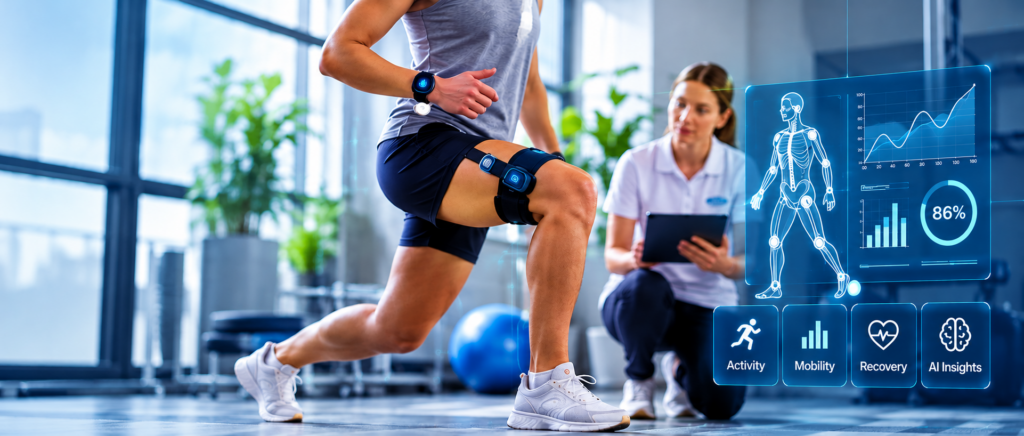
Connecting wearable technologies, clinical insights and interoperable digital health infrastructure to explore the future of musculoskeletal care, rehabilitation and injury prevention.
Transforming Musculoskeletal Care Through Digital Innovation
Musculoskeletal conditions, sports-related injuries and rehabilitation needs represent significant challenges for healthcare systems, professionals and individuals across Europe. Whether supporting an athlete’s recovery, monitoring physical performance or guiding a patient through rehabilitation, access to timely, reliable and meaningful health information is essential.
Yet, healthcare and rehabilitation processes often remain fragmented. Physiological measurements, movement assessments, laboratory findings and clinical observations may be collected through different technologies and maintained in separate systems, limiting their combined value for healthcare professionals and patients.
Addressing this fragmentation requires more than introducing new monitoring devices. It requires an integrated digital health ecosystem capable of bringing together heterogeneous data sources, supporting their interpretation and enabling more personalised, continuous and evidence-informed care.
This is the vision behind the Musculoskeletal & Rehabilitation DemoScale Lab, implemented within the European IRHIS project, where Gnomon Informatics SA contributes its expertise in digital health, interoperability and remote patient monitoring through its eHealthPass platform.
Working alongside a multidisciplinary consortium of European technology providers, healthcare organisations, research institutions and innovation partners, Gnomon is helping demonstrate how complementary digital technologies can be combined and validated in real-world healthcare and sports environments.
The IRHIS DemoScale Lab: Bringing Complementary Technologies Together
The IRHIS Musculoskeletal & Rehabilitation DemoScale Lab explores the integration of innovative wearable technologies and digital health services to support three interconnected areas: physical performance monitoring, injury prevention and rehabilitation.
Its approach combines physiological and biomechanical measurements with clinical and laboratory information, creating opportunities to better understand how different health indicators relate to physical activity, recovery and functional progress.
Three complementary technological solutions play a central role in the demonstration activities:
Continuous Lactate Monitoring
IDRO’s wearable technology supports non-invasive lactate monitoring through sweat analysis. Lactate-related measurements can provide useful information about physiological responses during physical activity, contributing to the exploration of exercise intensity, physical exertion and recovery patterns.
Cardiac and ECG Monitoring
Zive’s wearable technology enables cardiac activity monitoring through ECG measurements. Integrating cardiac information with other physiological and activity-related indicators creates opportunities for a more comprehensive assessment of responses to exercise and rehabilitation activities.
Motion and Rehabilitation Monitoring
TwinRehab motion sensors capture movement-related information through inertial sensing technologies. Within rehabilitation scenarios, such measurements can support the assessment of movement characteristics and functional progress, providing objective information alongside clinical evaluations.
Each technology offers a distinct perspective. Their combined value emerges when information can be brought together, interpreted within the appropriate context and made available through interoperable digital services.
eHealthPass: Connecting Devices, Data and Healthcare Stakeholders
At the centre of Gnomon’s contribution to IRHIS is eHealthPass, the company’s digital health platform designed to support integrated, patient-centred care and remote health monitoring.
Within the DemoScale Lab, eHealthPass provides the technological environment for integrating and managing data originating from different wearable solutions and pilot activities.
Through dedicated interoperability mechanisms and APIs, the platform enables heterogeneous measurements to be associated with individual participant records and made available to authorised stakeholders according to their respective roles and permissions.
This approach supports the transition from isolated measurements towards a more unified digital representation of the participant’s health and monitoring information.
The platform’s role extends beyond data collection. It provides the foundation for combining wearable-generated measurements with relevant clinical information and laboratory biomarkers, collected by affidea diagnostics, while also supporting subsequent data analysis and the development of advanced digital health services.
By connecting multiple technological components within a common environment, eHealthPass helps address one of the most persistent challenges in digital healthcare: turning fragmented health information into interoperable, accessible and potentially actionable knowledge.
Real-World Validation: From Sports Monitoring to Patient Rehabilitation
An important characteristic of the IRHIS DemoScale Lab is its emphasis on real-world validation.
Rather than examining individual technologies exclusively under controlled laboratory conditions, the project brings them into practical settings involving athletes, healthcare professionals, researchers and rehabilitation patients.
The demonstration activities are organised around complementary pilot scenarios.
Sports Performance and Injury Prevention
One major application focuses on athletes participating in organised training activities.
In Greece, pilot activities coordinated by the Aristotle University of Thessaloniki have involved athletes from different sporting disciplines, including basketball, volleyball, gymnastics, rowing and athletics.
These activities combine wearable-based physiological monitoring with clinical assessments, laboratory examinations and sports-related information.
The involvement of healthcare and diagnostic partners, including Affidea, further strengthens the multidisciplinary approach by enabling the collection of laboratory biomarkers alongside measurements obtained during physical activity.
The objective is to explore relationships between physiological responses, laboratory findings and training-related indicators, supporting future approaches to more personalised performance monitoring and injury prevention.
Home-Based and Clinical Rehabilitation
A second application focuses on rehabilitation patients and the use of motion-related information to support recovery monitoring.
Led by EUC Portugal, this pilot scenario incorporates movement assessment technologies and the TwinRehab solution, which explores digital approaches to rehabilitation monitoring and the representation of recovery trajectories.
Through interoperability mechanisms, relevant information from this environment is intended to be integrated into eHealthPass, allowing further exploration of combined data visualisation and analysis.
This creates opportunities to investigate how rehabilitation-specific information can complement broader digital health records and remote monitoring services.
Combined Technology Demonstration
A further pilot scenario explores the combined use of the participating wearable technologies.
By bringing together complementary measurements from different devices, the DemoScale Lab aims to investigate how multidimensional health information can contribute to a more comprehensive understanding of physical activity, musculoskeletal function and rehabilitation progress.
Together, these scenarios demonstrate the importance of validating digital health technologies across different environments, participant groups and care pathways.
Exploring the Potential of AI and Advanced Data Analysis
Collecting and integrating data is only the first step towards more intelligent digital health services.
Another important dimension of IRHIS is the exploration of artificial intelligence and advanced analytical methods capable of extracting meaningful information from the datasets generated during the pilots.
In collaboration with the project’s AI partners, including AICRUM and TUE, Gnomon has established API-based data exchange mechanisms to support access to relevant pilot information for further analysis.
The intended analytical activities include exploring relationships between physiological, laboratory and movement-related indicators, as well as identifying suitable approaches for presenting the resulting information to healthcare professionals and other authorised users.
Particular attention is given to the interpretability and explainability of AI-generated outputs, recognising that healthcare technologies must provide information that can be meaningfully understood and evaluated by their users.
Interoperability as a Foundation for Scalable Digital Healthcare
One of the broader contributions of the IRHIS DemoScale Lab lies in demonstrating the value of interoperability.
Wearable technologies, rehabilitation applications, clinical information systems and analytical tools often operate within different technological environments. Without effective integration, their outputs risk remaining disconnected.
Gnomon addresses this challenge by building on its extensive experience in healthcare interoperability and standards-based digital health architectures.
Through eHealthPass, the company supports the integration of heterogeneous information and its structured exchange across participating systems.
This approach is particularly relevant in the context of Europe’s evolving digital health landscape, including the European Health Data Space (EHDS), which places increasing emphasis on secure, interoperable and meaningful access to electronic health data.
Although the IRHIS pilots focus on specific musculoskeletal and rehabilitation use cases, the underlying architectural principles have broader relevance.
They illustrate how modular digital health infrastructures can support the integration of emerging technologies without requiring healthcare organisations to operate each solution as an isolated system.
Collaboration Across the European Digital Health Ecosystem
The DemoScale Lab also demonstrates the importance of collaboration between organisations with different but complementary areas of expertise.
Technology providers contribute innovative sensing and monitoring solutions. Clinical and research partners design and conduct pilot activities, collect measurements and contribute scientific expertise. AI partners investigate advanced analytical approaches, while Gnomon provides the digital health integration capabilities needed to connect the different technological components.
This multidisciplinary cooperation is particularly valuable when developing solutions intended for practical healthcare environments, where technical functionality must be considered alongside clinical relevance, usability, data protection and operational constraints.
The implementation process also provides important lessons regarding the realities of deploying emerging technologies.
Equipment availability, device reliability, heterogeneous data formats, participant recruitment and the coordination of multiple pilot environments all influence the pace of implementation.
Addressing these challenges requires continuous technical support, close cooperation between partners and flexibility in project planning.
Beyond individual technological outcomes, this experience contributes valuable knowledge on how complex, cross-border digital health innovations can be developed, integrated and evaluated collaboratively.
Looking Ahead: Towards More Connected and Personalised Rehabilitation
As IRHIS progresses, the Musculoskeletal & Rehabilitation DemoScale Lab continues to focus on completing its pilot activities, strengthening interoperability between the participating technologies and exploring the potential of advanced data analysis.
For Gnomon Informatics, the work represents another step in the evolution of eHealthPass as an interoperable platform capable of supporting diverse digital health use cases.
The longer-term ambition extends beyond individual wearable devices or specific rehabilitation scenarios.
It is about establishing the technological foundations for healthcare services in which relevant information can follow the individual across different monitoring environments, supporting continuity of care, more informed decisions and increasingly personalised interventions.
The IRHIS experience highlights an important principle for the future of digital healthcare:
The greatest value of innovation does not come from collecting more data in isolation, but from connecting technologies, people and information in ways that make healthcare more integrated, meaningful and responsive to individual needs.
Through its participation in IRHIS, Gnomon Informatics remains committed to advancing interoperable, secure and patient-centred digital health solutions, working alongside European partners to bridge the gap between technological innovation and real-world healthcare needs.
For more information, please contact:
Dr.Apostolia Karabatea
R&D Manager
Gnomon Informatics SA
[email protected]
 .
. 
IRHIS is co-funded by the European Union through the Interregional Innovation Investments (I3) Instrument.
The views and opinions expressed are those of the authors and do not necessarily reflect those of the European Union or the granting authority.